Saturday, August 14, 2010

Edinburgh Castle

Up from Princes Street Gardens we visited Edinburgh Castle. The castle hill has been fortified for a good 1300 years, and bits of various centuries are evident in its grounds. And bits of wild Scotland as well, as you can see here. From the top of the wall you can look back at Calton Hill and the Firth of Forth beyond. Hmm, I believe that is either the Scottish National Gallery or the Royal Scottish Academy.

St. Margaret's Chapel , dedicated to Queen Margaret who died here in 1093 and was canonized a saint in 1250, is the oldest building in Edinburgh--built in Romanesque style in 1130. Still popular for a venue for weddings, our guide said it is particularly popular with the father of the bride as only 20 guests can be accomodated.

Not sure which window I'm looking thorough here, but the building was a barracks for soldiers stationed here. It is still officially an army base, but only the commanding officer's residence is occupied as housing today.
The gun that fires at one o'clock each day but Sunday is here on Castle Hill, but it's not thtis one. This is Mons Meg, a massive medieval siege gun which was presented to King James IIin 1357 and used in war against the English. It was also used for firing salutes. The gunstone from one firing in 1588 was found almost two miles away.  I'd say, stay clear--look at the size of those cannonballs. It's barrel burst when it was last fired in 1681.  And interesting story about the castle's guns--Queen Victoria visited the castle during her reign and was most upset that there were no cannons. She ordered that cannons be secured for the Castle--I mean, what is a castle without cannons. A search was made and cannons were secured which now grace the area, but all that could be found were naval cannons.

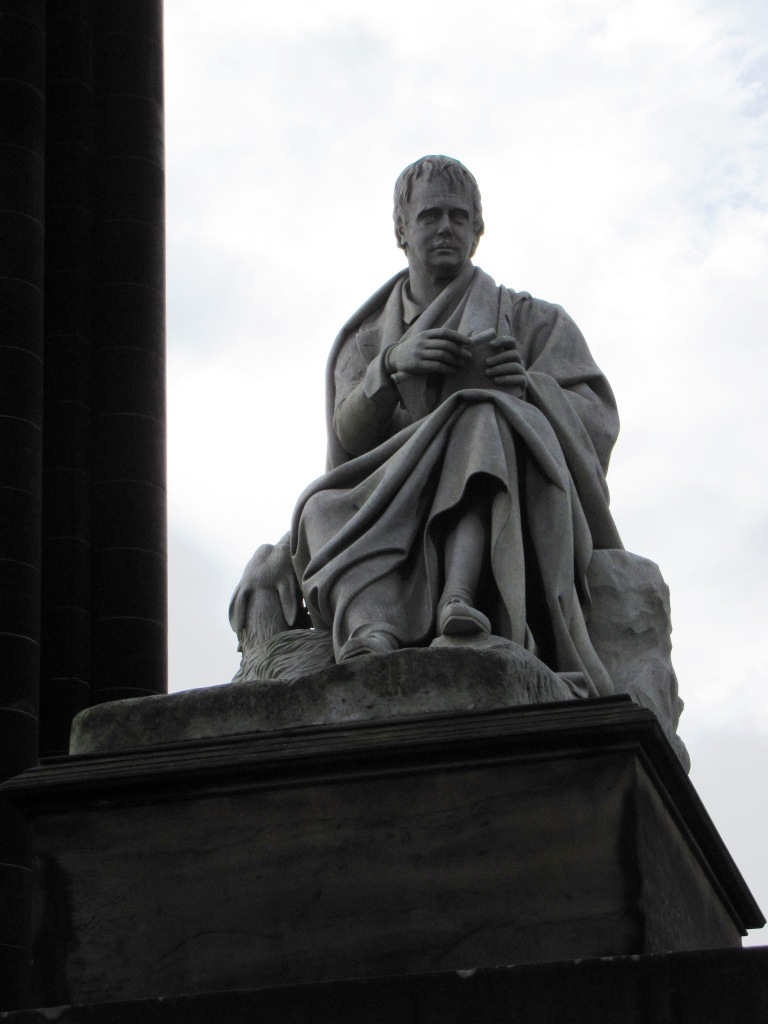
Another long view to Calton Hill from the walls, that spire in the center is the Scott Monument where the statue of Sir Walter Scott sits reflecting. It is 287 steps to the top for a fantastic view of the city. The view from the caslte and from Calton Hill was enough for us.
Looking out past Princes Street Garden toward the Firth.
Will our day and a half in Edinburgh ever end? Watch here for tea with a local blogger and various other tidbits including Greyfriars Bobby, pub signs, and some guys rappelling down the Parliament Building. You can fit a lot into a day and  a half--probably even more if you don't start out by getting lost.

Friday, August 13, 2010

Reflecting in Edinburgh

Sir Walter Scott on the Scott Memorial. He must be reflecting on something, don't you think? And Hume--he's probably reflecting on how silly it is to fall into the bog.
Adam Smith undoubtedly reflecting on the economy. Oh, dear!
And Sir James Young Simpson reflecting on anesthesia. (He got the middle name, BTW, because there were two James Simpsons in the medical school at the same time. The registrar appended the young to his name to tell them apart. It stuck.)                                                
Gerard Manley Hopkins reflects on the world.
Ah, here is a reflection as you might have been looking for. Here, in Chambers Street, where Robert Louis Stevenson studied in the law school reflected in the window, and obviously reflected on the fact that he would rather be writing!
James sponsors Weekend Reflections. I hope you and he can abide my bit of whimsy with the theme this week.

Thursday, August 12, 2010

Princes Street Gardens--Edinburgh

I referred to my guidebooks and notes to check the information about the Princes Street Gardens and found some information we didn't hear. Here, directly from  Frommer's Scotland: 
 As the New Town grew, the city fathers decided to turn the area below Edinburgh Castle into the Princes Street Gardens, now one of the city's main beauty spots. The area was once Nor Loch, a body of water in the city center, but it was drained to make way for a railway line. (When it was still a bog, the great philosopher David Hume fell in, couldn't remove himself, and called for help from a passing woman. She recognized him, pronounced him an atheist, and wouldn't offer her umbrella to pull him out of the mire until he recited the Lord's Prayer.)
We didn't hear the story about Hume while we were there, but we were told several stories about the area's state before the Loch was drained.

It was drained around 1800, but before that it was the sewer and the reservoir (Join me: "eeeeeeywwwww!!!!") The city's nickname was "Auld Reekie" because of Nor Loch and the smoke from factories.

It was also used for drowning witches. Those suspected had their thumbs tied to their ankles and were dunked. If they survived, then they were assumed to be witches and were burned as such. If they drowned, it proved their innocence and they were given a Christian burial.

Now, why didn't Frommer's tell us that?

We climbed the path up from Princes Street Gardens to the castle, seen here with the gray skies we had our whole time in Scotland. (SkyWatch time everyone--for more of the world's skies visit here.)

Calton Hill--Edinburgh

Calton Hill was purchased by Edinburgh's town council in 1724 and established as one of the nations first public parks. It's geologic origins are volcanic and glacier carved from the ice ages. It provides an incredible view of the surroundings and was a spot where quite a number of monuments were erected for various purposes. The imposing one to the left is in honor of Dugald Stewart, an Edinburgh born writer and philosopher.
The National Monument commemorates Scottish soliers lost in the Napoleonic Wars. It is based on the design of the Acropolis in Athens and was part of the architectural renaissance which gave Edinburgh the nickname, the Athens of the North. Does it look like it fell into ruins? No, they ran out of funding and stopped.

The castle like building is the City Observatory. I can't find a reference for the obelisk.  I'll look later.
The hill path is a lovely walk. Here we are approaching the Nelson Monument, in honor of Admiral Horatio Nelson, who died leading his troops in the Battle of Trafalgar. (We'll see him again in London.) This monument is designed after an upended telescope. You can see the resmblance better in the next picture. It also serves--or served--a practial purpose. A large white ball on the side facing the Firth of Forth is raised each day and dropped precisely at 1:00 p.m. This served as a time signal for the ships in the firth to set their instruments by. Of course, fog and rain prevent that from being as practical as it might seem, so an additional signal of a cannon shot from the castle was added. That is still done daily except Sunday as a tradition, though modern instruments make it unnecessary for navigation purposes.
The view from Calton Hill includes Edinburgh Castle in the distance, The Walter Scott Monument, St. Giles Cathedral, the National Gallery of Scotland, and the Royal Scottish Academy. In the opposite direction you can see Arthur's Seat, another volcanic mound--and a link to Scottish connections to King Arthur.


Working

When you spend fifteen hours in a single day on a series of airplanes, you learn to appreciate the work of the flight crew.


I think that my body has finally accepted Pacific Time again.

Wednesday, August 11, 2010

But then...

Hedgerows and Chimneypots


Now that may seem an odd title. My first impression as we flew over the country was hedgerows. We don't tend to have hedgerows in North America, perhaps because of the size of our farms. But you can clearly see them from the air, dividing the fields in an amazing patchwork. Did the crazy quilters of the Victorian age realize that they were reproducing the shapes of the farmland?

And I was asked when I mentioned the chimneypots if we don't have chimneys--but of course, some of us do, and many don't have fireplaces so they don't. But we don't have the rows of chimneys on a building, nor the chimneypots which, I am sure, serve a practical purpose as well as being rather decorative. (to my eye, anyway.)
Edinburgh is an old city. How old depends on which part you are looking at. Parts of the castle date from the 11th century, and the "Old Town" built up around that (more later.) But even as you go further out from that city core, the "New Town" came into being two or three hundred years ago and many streets retain that flavor--at least on the outside. Interiors are very up-to-date. Garden spaces are very compact. Just as any other city, as you reach the outskirts there is more space.
But take a look at this bus negotiating the streets in the "Royal Mile"--the very center of historic Edinburgh. Yikes!

Tuesday, August 10, 2010

ABC Wednesday--D--and catch-up

The Seventh round of ABC Wednesday has reached the letter D and I promised something special on my return from my adventure. I dread that I cannot deliver. Destiny denied us. Tight schedules, bus breakdowns and clunks from motorbikes, and our plan to meet the creator of ABC Wednesday, dear Denise, and her husband Jon were not to be. DARN!


I did get to talk to her--here I am talking to Denise while waiting for a train. We talked several times trying to sort out how we could meet. But it wasn't to be.


Here is a lovely illuminated D we found in a display of calligraphy at Lincoln Cathedral--just the sort of thing that Denise might enjoy.
For Catch-Up--here is my B--a member of the Yeomen of the Guard at the Tower of London--the "Beefeaters".

And my C--a castle ruin in Wales.

Definitely a clue to our Adventure--a trip to Scotland, England and Wales which you will see quite a bit of in the next few weeks here and in my 365 No Themes No Memes photos only blog.

Sunday, August 8, 2010

Sunday's Psalm--19th Sunday of Ordinary Time

Blessed the people the Lord has chosen to be his own.

Exult, you just, in the LORD;
praise from the upright is fitting.
Blessed the nation whose God is the LORD,
the people he has chosen for his own inheritance.

Blessed the people the Lord has chosen to be his own.


See, the eyes of the LORD are upon those who fear him,
upon those who hope for his kindness,
To deliver them from death
and preserve them in spite of famine.


Blessed the people the Lord has chosen to be his own.


Our soul waits for the LORD,
who is our help and our shield.
May your kindness, O LORD, be upon us
who have put our hope in you.
Blessed the people the Lord has chosen to be his own.


from Psalm 33
Photos: duck on a Spokane pond, rowboat at Deer Lake, Mendenhall Glacier-Juneau AK

Sunday, August 1, 2010

Sunday's Psalm--18th Sunday of Ordinary Time

If today you hear his voice, harden not your hearts.

You turn man back to dust,
saying, “Return, O children of men.”
For a thousand years in your sight
are as yesterday, now that it is past,
or as a watch of the night.

If today you hear his voice, harden not your hearts.

You make an end of them in their sleep;
the next morning they are like the changing grass,
Which at dawn springs up anew,
but by evening wilts and fades.

If today you hear his voice, harden not your hearts.

Teach us to number our days aright,
that we may gain wisdom of heart.
Return, O LORD! How long?
Have pity on your servants!


If today you hear his voice, harden not your hearts.

Fill us at daybreak with your kindness,
that we may shout for joy and gladness all our days.
And may the gracious care of the LORD our God be ours;
prosper the work of our hands for us!
Prosper the work of our hands!

If today you hear his voice, harden not your hearts.

from Psalm 90
Photos: Yakima River Canyon, along Eastside Trail-Mt. Rainier Park, Sunrise in the Inside Passage to Alaska